Oct 3 2008
Diacritical Challenge
Squiggly Bits
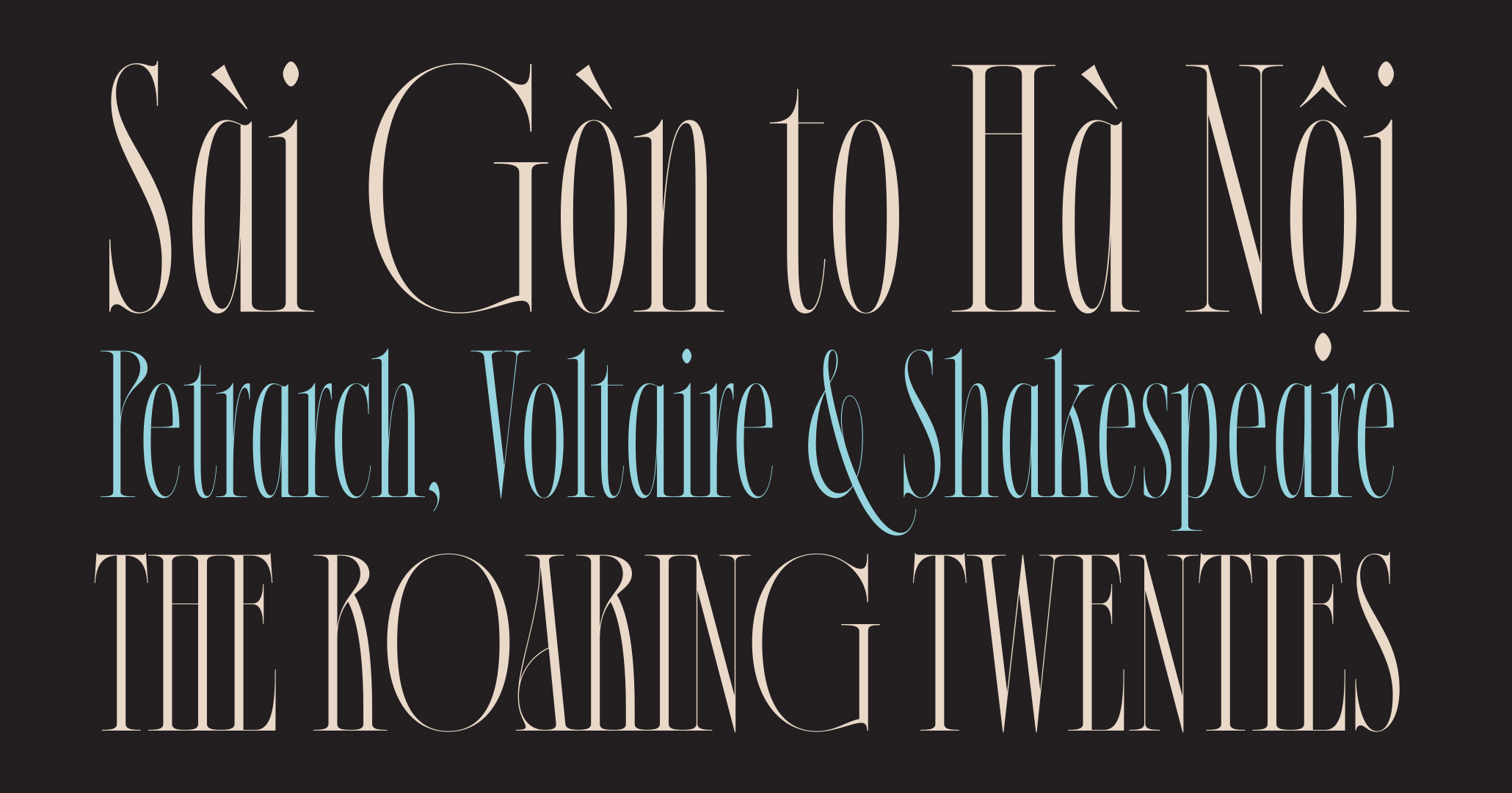
This poster makes reference to the paucity of diacritics in English. And, when they are employed, they’re often used on loan words—like the French café, for example. Here’s a little pre-Sunday Type challenge for you: name all the diacritics (or diacritical marks), and name the typeface used.
Poster designed by Michael Ciancio (you’ll need to click on the English Language link on the left to see the poster—the site uses frames).
Thanks to Kate Allen who said she thought of me when she first saw this poster. I take that as a compliment :) I guess I should offer a prize. Any suggestions?
See you on Sunday!





Dustin Senos
That’s a stunning poster. I want one.
Oct 3, 2008
Brad Blackman
I see Gill Sans, but I can’t tell you what all those funny marks are for the life of me, except for the tilde over the “n.”
Oct 3, 2008
johno
Brad
Gill Sans correct; and tilde is correct too. That’s one…
Oct 3, 2008
andrew
and my favorite, the umlaut over the second ‘a’ in character
Oct 3, 2008
Sílvio
Well, let me try:
circumflex above the i and the e; acute above the E and the r; dotaccent above the g; caron above the s and the c; ring above the a; tilde above the a and the n; the d with the bar is usually referred to as dcroat, but i don’t know if this bar has a special name…; slash crossing the o; macron above the e; comma accent under the t and cedilla under the c and the s; dieresis above the a; grave above the e. Plus we have the german double s, that obviously is not a diacritic, but isn’t as well used in english.
Everything ok?
Oct 3, 2008
Vikki
If we’re talking Irish language (or gaelic) then the mark over the E would be a fada or a síneadh fada.
And are there possibly marks from the Pinyin language? because those would be Mid-tones (3rd tones), perhaps over the s and the c. And a normal or flat tone (1st tone) over the e.
Oct 3, 2008
Hollis Ervin
Well that “a” is a dead give-away for gill sans, and I see some tildes, circumflices, a ring, an esszett, a slashed “O”, cedillas, an eth, an undercommaed “t”, a macron above the “e”. I don’t know what the dot above the “g” is called, unless it’s called a dot.
Oct 3, 2008
Bernt
I think it needs an European to help you out
From the french: The î in wish is called accent circumflex (also present on the ê in interesting), the é on english accent aigu, on characters there is the ç called c sedille and the è called accent grave.
German offers here the ß es-zet in interesting and the ä a-Umlaut in characters.
From the Scandinavian languages are starred the å which I don’t know the name but which has a similar function as the german Umlaut in language and so does the ø in more.
Speaking of more, I would say the sign on the e is a sign from the japanese transcription language which has the function to double the length of the tone, but I could be wrong.
The d in had looks very islandish to me… and turkish the s in characters.
From slavic languages I think there are signs like the s in English and the second c in characters.
Cheers
Oct 3, 2008
Matias
Oh, I only know the ñ from spanish, the ã and ç from portuguese and the î from french.
Oct 3, 2008
Matias
And I wonder how these words would sound if pronnunciated according to all that diacritics.
Oct 3, 2008
Simon Pascal Klein
Typeface: Gill Sans, by Eric Gill.
Diacritical marks and language-specific characters in order of appearance: circumflex (ˆ), acute accent (´), caron/hácek/wedge (ˇ), kroužek/ring (˚), tidle (˜), dyet*, slashed o (ø), macron (¯), eszett ligature (ß), undercomma (¸), cedilla (ç), umlaut/diaeresis (¨), grave accent (`).
* Couldn’t figure out a way to generate a dyet—sorry.
Sad to see the breve (˘) missing. ;)
Oct 3, 2008
Neels de Coning
Gill Sans I agree. The dot adove the g is an overdot.
The d with the bar – dcroat – is that used in English?
Oct 3, 2008
Simon Pascal Klein
@Neels de Coning: knew I missed something!
Oct 3, 2008
Dan
Lovely poster indeed. But careful what you wish for! Having diacritics means a few annoyances when designing, like making sure you have enough leading (or try setting something in all caps with multiple rows and negative leading… not pretty). Some typefaces have the diacritics of ă, î, â (I’m Romanian) set higher than ascenders which causes more headaches. Oh, and you can forget about discretionary ligatures in most cases as they become too distracting to read alongside all the “squiggly things” (as an American friend puts it).
Oct 3, 2008
Matt
Awesome work. loving the simplicity.
Oct 3, 2008
Kristian Kruse
Well in Denmark we have the Æ Ø and Å - they are very difficult to pronounce for foreigners and stupid when having things shipped from abroad. However, the can also be written in the old fashioned way making it easier when using internationally: æ = ae, ø = oe, å = aa.
Furthermore, there is dicussion about removing them from the Danish alphabet as we are focusing so must on the world around us. We have English in 2nd grade and 3rd language in 4th (French or German, but will properly soon also have the option of Spanish).
I really like the poster as well!
Oct 3, 2008
David Březina
Sílvio is right. Assuming you wanted the English names.
Dcroat is a short glyph name for Croatian D/d (I think it reads as “dj” in English). The diacritical mark is a bar, though. The dot above -g- is usually called a “dot accent”. Overdot is also correct I guess.
I only wish these Gill Sans accents were designed with more care:
- ring, slash, and macron are too light (even though some people might like it this way, esp. slash and ring)
- accents above -a- are oddly positioned (too much to the right)
- acute, grave, circumflex, and caron does not seem well related to the typeface design
And to finish my criticism :) pinyin is a romanized system of transliterating Chinese. It is not a language. However, diacritics are often used in different national alphabets/transliterations and do not necessarily represent always the same sound.
Lovely poster! Very good that people realize that there are more than 26 letters of the Latin alphabet.
Oct 3, 2008
Kristian Kruse
And “møre” in Danish is “tender”! ;-)
Oct 3, 2008
Gabriel Radic
The poster is mighty cool. It reminds me of IñţërñățîôɲǎłíΖαtìøηş, the text I use to test Unicode support in a font or CMS.
[RO] Bună @Dan, şi eu sunt român. [/RO] The accepted typographic convention is to not use accents on abbreviations. I can’t say for sure about uppercase words in-line, the first capital in a name or sentence, I know I simply don’t use them.
Oct 3, 2008
paul
i wish these Gill diacritics were more harmonious!
(one example: gdotaccent vs. i, why is the dot on g square???)
Oct 3, 2008
vlad
Hi! Very nice poster, love it, really!
Just a quick tip: in Romanian (the other two guys didn’t mention it) the ș ț ă â are considered to be actual letters and they are distinct phonemes. Which makes them pretty important.. i remember in first grade, everyone was saying the alphabet with those 4 included.
Oct 3, 2008
ichosis
This brings to my mind title of Twardoch’s slides [i]That annoying noise around letters. Latin diacritic character design[/i], you can see it here: [url]http://www.twardoch.com/adam/project.php?pid=0062[/url]
Oct 3, 2008
Martin McNickle
You have to love the names of these things, they sound fantastic. I wish I had more occasion to use these, the closest I get is setting formulae — there are some nice physics constants that use diacritics.
Oct 3, 2008
ugla
i think the carons and circumlfexes are too small and most of the accents are oddly positioned… so i wish the english language had more interesting characters as well, so everyone knows how they should look like :) the poster is nice anyways! cheers
Oct 3, 2008
Dan
@ Johno,
It seems you have acquired a Romanian following!
@ Gabriel Radic
[Salut!] Let me explain myself: let’s say you’d want to set a short paragraph in all caps (or small caps, for that matter) and you’d reduce the leading to the point that the rows would be almost sitting on top of each other. You couldn’t do that because of the diacritics.
Oct 3, 2008
David Březina
@ Gabriel Radic “The accepted typographic convention is to not use accents on abbreviations.” This is interesting! This is definitely not general rule for all languages, but is it really the way you would do it in Romanian? For both acronyms and abbreviations? Why is that?
Oct 3, 2008
MattiaC
yes I wish it too… cause I cannot find some REAL foudry character with italian diacriticals!
see ya
,
matt
Oct 3, 2008
Gabriel Radic
@Dan: You’re right, I was only referring to the more common uses of caps. For all caps paragraphs, maybe it makes sense to provide spacing directly in you style, since this would something like a chapeau, not an isolated occurence. Or maybe it is, and then you’re screwed :-)
@David Březina: This is the case for French and _I think_ also for Romanian. I did DTP full-time for some pretty important Romanian publications, yet can’t remember this for sure.
Oct 3, 2008
carolina falcão
ok, let’s go. it’s gill sans, of course.
now the lovely diacritics, in order of appearance:
circumflex
acute
overdot
caron
ring
tilde
dyet
slashed o
macron
tilde
acute
circumflex
eszett
undercomma
cedilla
diaeresis (or umlaut)
caron
grave
cedilla
.
Oct 3, 2008
martin
You have the Swedish character å. Or rather a character similar to this character, your is too fugly to be of Swedish origin. And something that resembles the Swedish character ä.
Common Swedish characters:
- Å -
Developed from an A with an O on top.
- Ä -
Developed from an A with an E on top.
- Ö -
Developed from an O with an E on top.
- Ñ -
Mostly spanish loan words. Characters “nj” is pronounsed similar in Swedish and is sometimes used instead.
- É -
Mostly french loan words.
- Ü -
Mostly German loan words and names. The character “y” is pronounsed similar in Swedish and can be used instead. When there is no Swedish word with the same spelling, “u” can be used.
Rare Swedish characters:
- Z -
Words of Greek origin.
- W -
Now only used in names. Used in old Swedish spelling, as in old spelling of “Swedish”: “swänsk”, now: “svensk”.
Ä and Ö is similar in use to Æ and Ø in some other Scandinavian languages. Å, Ä and Ö also looks similar to characters with diacretics, used in other, non-nordic, languages, but they are used completely different (and don’t look the same, ÅÄÖ are characters, not characters with diacretics).
Names of persons from countries with latin characters is spelled with the same diacretics as they would in their own language. Other names (like cities or countries) are usually Swedified.
Sometimes, when it’s unclear how a loan word would be pronunced otherwise, we use diacritics from other European countries with Latin characters, and Russian or Icelandic characters.
Typographically Swedish is a lot different from English and other languages. We have never had any type foundries, to speak of, of our own. In the lead type days we managed by modifying matrices and other equipment from other countries (mostly German, French and Brittish), and by skillful type setters that adjusted the spacing of the types. Today we use fonts and typographic programs made for the English language (or Unicode, which is the same thing) and it looks awful.
Oct 3, 2008
Pat
This guy don’t know what he means, I speak spanish and we only have this kind of characteres á, é, í, ó, ú and this ü only, and is so complicated sometimes, I can’t picture how dificult most to be to people in russia to write. English is OK.
Oct 3, 2008
Brad Blackman
Wow, this has been fascinating. Too bad English doesn’t use interesting marks, but I see how it messes up leading and throws a wrench into other things (and makes it typesetting more complicated and tedious than it already is.)
Great post! Thanks for sharing it. I now know more about diacritics!
Oct 3, 2008
Gabriel Radic
@Pat: Russians, like Greeks, have a different alphabet. I don’t know if they even have accents or diacritical letters. Vietnamese, OTOH http://en.wikipedia.org/wiki/Vietnamese_alphabet#Letter_names_and_pronunciation
Oct 3, 2008
Jens Alfke
Too bad the poster didn’t use any Vietnamese — they put multiple accents on a letter, sometimes up to three, until the letters look like porcupines or Swiss Army knives. (Must have been some Frenchman who came up with the Latinization of their language; what was he smoking?)
The poster also reminds me of some internationalization (abbrev. “I18N”) tools for computer software that generate fake translations by just taking the English and adding accents to all the letters. This is a good way for monolingual developers to find parts of their code that break on non-ASCII text, or places where the program has hardcoded English text instead of looking up the translation.
Oct 3, 2008
Lucas S.
Don’t forget the tittle. :) With a name like that it has to be interesting.
Oct 3, 2008
Dave Walker
I did a menu for a Vietmanese restaurant last year with all the menu items in Vietnamese. Figuring out the different diacriticals was a nightmare (a ‘u’ with a horn? Seriously? Actually: ư ), but worse was trying to find the HTML entity codes for all the different characters. BTW, fileformat.info saved me on this project.
I agree with Jens: the person who inflicted this on the Vietnamese was smoking good Southeast Asian opium.
Oct 3, 2008
Ampersanderson
Way to go Mikey!!
Oct 3, 2008
Betsy A Brady
Must get this blown up on stretched canvas, http://www.CanvasPress.com and put it beside my desk. A reminder how much there is to love about typography
Oct 3, 2008
Carson Park Ranger
Don’t try to enter the United States with that poster. It’s a clear violation of Homeland Security.
Oct 4, 2008
Ingeborg
cool poster
the a with the circle over it and the o with the line through it are extra letters in themselves….
Oct 4, 2008
Sam Parkinson
I love the poster, just with I could get the document to print it myself :P
Maybe he should start selling it…
Oct 4, 2008
Kit
Speaking of Romanian diacritic pedantries, please remember not to use incorrect (Microsoft-style) Turkish ‘ş’ and ‘ţ’ (s and t with cedilla) — Gabriel, I’m looking at you :) — over correct Romanian ‘ș’ and ‘ț’ (s and t with comma below).
Oct 5, 2008
stefano picco
simply true!
Oct 5, 2008
JC
English is a mess. Is uses and abuses from the entire world of languages.
That is what makes it one of the greatest languages on Earth.
Oct 5, 2008
Textwrapper
Very good title on this post. I always try to come up with good puns (not an oxymoron) for the post headings on my local political blog, and it ain’t always easy.
Oct 5, 2008
Gabriel Radic
@Kit: Been there, done that, only to have my readers complain about the recțangleș in the text. Sad, but support for the proper Romanian letters isn’t quite widespread yet. And the iPhone fonts are a step back for “Mac OS” in this regard.
Oct 6, 2008
Creative Agency
Gill Sans or Humanist.
Oct 6, 2008
ralukkia
Oh, no, Thank God English does not have diacritics!!!
Oct 7, 2008
steelfrog
I’m a native French speaker (and thus, writer) and let me tell you that we’re letting you off easy not having to deal with diacritics. English is by far one of the easiest languages I’ve ever learned, and definitely the easiest latin-based.
Oct 10, 2008
Srđan
I was so excited to see what some of you called the dcroat - the ‘d’ with a bar (as in ‘had’), because I have that very sign in my name and I use it very rarely (my e-mail for instance).
Someone said correctly - it is pronounced ‘dj’ in English, but note the difference between đ and dž, the latter is like ‘j’ in ‘joy’ or ‘g’ in ‘gym’, while the former is a somewhat “softer” version of it.
Yeah, I know, Croatian seems complicated :)
Oct 10, 2008
weberica
yes, i would like it too :), than I could use more fonts and not be limited on those few with croatian caracters (č, ć, š, đ, ž)
Oct 11, 2008
Kit
“And the iPhone fonts are a step back for “Mac OS” in this regard.”
Why, because they don’t replicate some Windows 95 mistakes that tend to corrupt the correct standards? Oh please! The iPhone glyphs are dead on correct — and that’s something that should be admired and embraced, not repudiated.
Better drop diacritics altogether than use some sloppy substitutions (ã or ǎ instead of ă, ş instead of ș, ţ instead of ţ).
Oct 12, 2008
Gabriel Radic
@Kit: No, I’ve meant that the correct diacrițicș “were” not properly rendered by the iPhone, so I had to revert to ţhe cedilla verşion. Seems to be greatly improved now, probably since the 2.0 update. Thanks for the heads-up.
Oct 13, 2008
Aleksejs
In latvian we use these:
ē ū ī ļ ķ ģ š ā ž č ņ
macron is used to lenghten duration of vowels
caron and cedilla are used to “soften” consonants
Oct 13, 2008
Degarden
My family name “Ødegården” (Norwegian) was once understood (by a public office in the UK) to be “Degarden”. (The woman behind the counter thought I’d made a mistake starting with an O, then thought better of it, and made a slash across it to annul it. Hence I had become Mr. Degarden, which is nice (too), however incorrect.)
Ø, ø and Å, å are (as already pointed out by others above) characters in Scandinavian alphabets – they are not diacritics as such. The Norwegian alphabet contains 29 characters (the same 26 as in English + æ, ø and å).
Oct 15, 2008
kat
That poster is my anthem!
Oct 19, 2008
Jarek
Why there is not a single ogonek there??? Duh. There are millions of Poles in the UK now, they could make at least one ę or ą.
Eh. ;-)
Oct 27, 2008
johno
Jarek
Especially for you:
Oct 27, 2008
Grzegorz Rolek
Damn, e with ogonek is the most elegant diacritical combination! There’s nothing artificial in it’s grapheme, just continuous calligraphic movement, so coherent, so simple. In fact, when this ogonek is properly executed it don’t even look like diacritic.
Oct 28, 2008
MAHONi
good work, Congratulations.
ç and ş from Turkish’s alphabet.
Nov 8, 2008